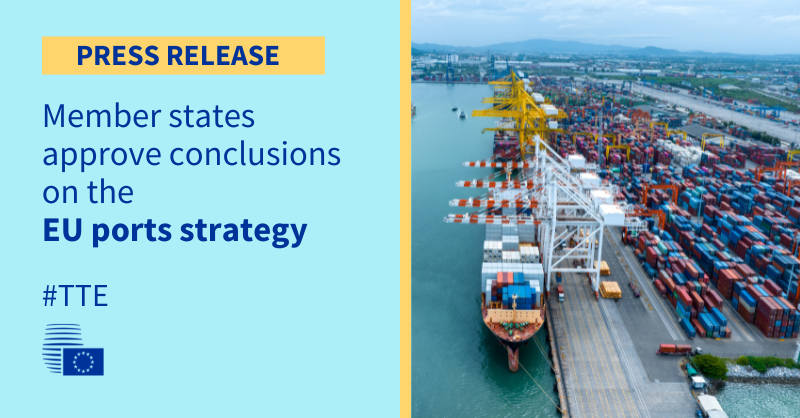
On 8 June 2026, member states approved Council conclusions on the European ports strategy, reaffirming the vital role ports play in strengthening the EU’s strategic autonomy, securing critical supply chains, accelerating the energy transition and maintaining Europe’s global leadership in waterborne transport.
The strategy seeks to address the key challenges facing European ports – both maritime and inland – in the areas of competitiveness, sustainability, resilience, security, digitalisation and social development. It builds on the foundations of the 2013 EU ports policy while responding to a rapidly changing geopolitical, economic and environmental landscape.
In their conclusions, member states underline the importance of ensuring the efficient and proportionate implementation of the strategy. They invite the European Commission to assess the effectiveness of existing EU-level coordination and governance structures and, where necessary, establish new mechanisms to support implementation.
The Council recognises that ports are increasingly evolving into multi-functional industrial hubs. As gateways for trade, energy and mobility, they must simultaneously expand capacity, decarbonise operations, accelerate digitalisation and strengthen security. At the same time, member states emphasise the need for a balanced approach that respects national, regional and local specificities while pursuing common European objectives.
Strengthening competitiveness
Given the global nature of maritime trade, European ports operate in a highly competitive international environment. The conclusions stress the importance of maintaining a level playing field by addressing distortions arising from regulatory asymmetries, unfair competition and certain third-country practices.
Member states call for continued efforts to secure fair market access for European operators in third-country port markets under balanced and non-discriminatory conditions.
The Council also welcomes the Commission’s intention to provide guidance on the assessment of foreign investments in EU ports. While stressing that European ports must remain attractive destinations for investment, member states underline that investment screening should be risk-based, proportionate and non-discriminatory. Particular attention should be given to safeguarding economic security and preventing undue foreign control over critical port infrastructure and operations.
Enhancing security and resilience
The conclusions note that ports are facing an increasingly complex security environment, including threats linked to terrorism, sabotage, organised crime, corruption, cyberattacks, hybrid threats and the threats posed by drones.
Against this backdrop, member states welcome existing and forthcoming initiatives aimed at strengthening the security and resilience of port infrastructure. These include the European Ports Alliance, enhanced cooperation with international partners and third countries, and the forthcoming proposal for an EU framework facilitating cooperation between member states on background checks for port workers.
Military mobility
Ports also play a critical role in military mobility and Europe’s defence readiness. As essential nodes for the movement of military personnel and equipment, ports contribute directly to the Union’s resilience and security.
Member states therefore stress that implementation of the ports strategy should be closely aligned with ongoing work on military mobility, facilitating the rapid deployment of forces and ensuring coherence with efforts undertaken within NATO.
Supporting the energy transition
Ports are recognised as key enablers of Europe’s energy transition, serving as hubs. The conclusions call for stronger support for onshore power supply (OPS), smart grids, electrification and enhanced grid integration, while ensuring that investments remain economically viable and aligned with actual demand.
Member states further underline the importance of accelerating grid deployment, permitting procedures and investments in clean energy technologies. They encourage the use of EU emissions trading system (ETS) revenues to support maritime decarbonisation throughout the value chain, including shipping, port infrastructure and alternative fuels.
At the same time, the Council acknowledges concerns regarding the impact of ETS and other climate-related legislation on the competitiveness of EU ports, including the risks of traffic diversion, carbon leakage and investment relocation. The Commission is therefore invited to continue monitoring these effects and, where necessary, propose targeted corrective measures while preserving the Union’s climate ambitions and ensuring alignment with international frameworks.
Investment and funding
The Council stresses the need to improve access to EU funding through greater transparency, better coordination and simplified procedures. Funding mechanisms should avoid unnecessary administrative burdens and remain neutral with regard to governance structures, concession models and operational arrangements.
Social cohesion and quality jobs
Ports make a significant contribution to economic development, resilience and territorial cohesion across the Union, particularly in island, remote, outermost and coastal regions.
The conclusions underline the importance of ensuring safe working conditions and investing in training, reskilling and workforce development to support the sector’s technological transformation. Particular attention should be given to attracting women and young people to careers in the maritime and port sectors.
Read the Council’s Conclusions on the EU Ports Strategy here: https://data.consilium.europa.eu/doc/document/ST-10345-2026-INIT/en/pdf